Water defines the Berguedà more than any other element. The region's limestone geology creates a hidden hydraulic architecture—underground rivers, massive aquifers, and hundreds of springs that surface where geology permits. This water wealth enabled human settlement in a challenging mountain environment and powered the industrialisation that transformed Catalonia. Understanding the Berguedà means understanding its hydrology.
Karst Hydrology: The Underground River System
The Berguedà sits atop extensive limestone formations laid down during the Mesozoic era (roughly 250-65 million years ago) when the region was submerged beneath tropical seas. Limestone consists primarily of calcium carbonate (CaCO₃)—a mineral readily dissolved by weak acids. Rainwater, absorbing atmospheric CO₂, becomes slightly acidic (carbonic acid). Over geological time, this acidic water dissolves limestone, creating a subsurface landscape as complex as the visible one.
This process, called karstification, produces characteristic landforms:
- Sinkholes (dolines): Surface depressions where underlying cavities collapse.
- Underground rivers: Surface streams that disappear into ponors (swallets), flowing through caves before resurfacing kilometres away.
- Springs: Points where underground water reaches impermeable rock layers and surfaces. The Llobregat springs exemplify this dramatically.
- Caves: Dissolution cavities ranging from tight crawlways to cathedral-sized chambers with speleothems (stalactites, stalagmites, flowstone).
The Berguedà contains over 200 documented caves, with new systems discovered annually by speleological groups. The Cova del Tabac near Montclar extends hundreds of metres, containing paleolithic archaeological deposits and serving historically as a smugglers' cache.
This underground hydrology functions as a massive natural reservoir. Rainwater and snowmelt infiltrate quickly, stored in fracture networks and cave systems, then released gradually through springs. This buffering effect moderates stream flow, preventing both flash floods and complete dry-season desiccation—crucial for both ecosystems and human water use.
Gorgs: Natural Pools as Geological Sculpture
The Berguedà's most celebrated water features are gorgs—natural pools carved by water erosion into bedrock. These form where streams descend through resistant limestone, creating waterfalls that plunge into basins scoured by hydraulic action. The process is physically simple but geologically slow: falling water carries sediment that abrades the bedrock in circular patterns, gradually excavating bowl-shaped pools.
Notable gorgs include:
- Gorg de la Cabana (Berga): A 4-metre-deep pool on the Bastareny river, accessible via a 30-minute forest walk. The pool's blue-green colour derives from suspended limestone particles refracting light.
- Gorg Blau (Bagà): Named for its distinctive turquoise water, caused by glacial flour—finely ground rock particles that scatter blue wavelengths more than others, the same phenomenon colouring alpine glacial lakes worldwide.
- Gorgs del Llobregat: A series of pools in the upper Llobregat valley, formed where the river descends through Paleozoic schist interbedded with harder metamorphic layers.
Gorgs function ecologically as refuge habitats during low-flow periods. When streams reduce to trickles in late summer, fish, amphibians, and aquatic invertebrates concentrate in pools, surviving until autumn rains restore flow. This pattern makes gorgs biodiversity hotspots.
For human use, gorgs provide swimming holes during summer months. However, increasing recreational pressure threatens these fragile systems. Soap, sunscreen, and physical disturbance all impact water quality and biota. Local environmental groups advocate low-impact use: no soaps or lotions, no removal of stones or logs, and respecting riparian vegetation that stabilises banks.
Historical Hydraulic Management: Wells, Fountains, Canals
Pre-industrial Berguedà society depended on sophisticated water management. Every village had public fountains (fonts) where spring water was channelled through stone conduits to central distribution points. These fountains served practical and social functions—water collection, livestock watering, laundry washing, and social gathering.
Many fountains display architectural refinement indicating their cultural importance:
- Font de la Plaça (Bagà): 15th-century Gothic fountain with carved basin and ornamental spout, located in the medieval arcaded square.
- Font del Roure (Berga): Renaissance-era fountain beneath an ancient oak (roure), traditional meeting point for shepherds.
- Font del Lladre (multiple locations): "Thief's fountain"—a common Catalan name for remote springs where travelers could drink without entering villages, supposedly used by fugitives.
Agricultural communities developed irrigation systems (rescloses and sèquies) diverting stream water to terraced fields. These systems required collective maintenance and water-sharing agreements, creating social structures that persisted for centuries. Water rights were property—bought, sold, and inherited—with complex rules governing distribution during drought.
The medieval Hospital de Peregrins in Berga (now demolished, but documented in archives) included a spring-fed cistern providing water to pilgrims travelling the mountain roads. Such hydraulic infrastructure was essential to maintaining trans-Pyrenean communication routes.
Contemporary Challenges: Climate, Tourism, and Conservation
The Berguedà's water systems face 21st-century pressures:
- Climate change: Regional climate models project decreasing annual precipitation, more intense but less frequent rainfall events, and reduced winter snowpack. These changes threaten groundwater recharge rates and alter the hydrological regime that existing ecosystems depend upon.
- Tourism pressure: Increasing visitors concentrate at popular gorgs, causing erosion, vegetation trampling, and water quality degradation. Some municipalities now limit access during peak summer weekends.
- Infrastructure aging: Historic fountain systems require maintenance. Some villages have restored fountains as cultural heritage projects, while others have fallen into disrepair as piped water systems replace communal sources.
Conservation initiatives include:
- Aquifer monitoring: The Catalan Water Agency maintains gauging stations measuring spring flow, providing data for sustainable water allocation.
- Riparian restoration: Reforestation projects planting native alders and willows along degraded stream banks, stabilising soil and shading water to moderate temperature.
- Education programs: Local environmental groups offer guided walks explaining karst hydrology and promoting responsible water use.
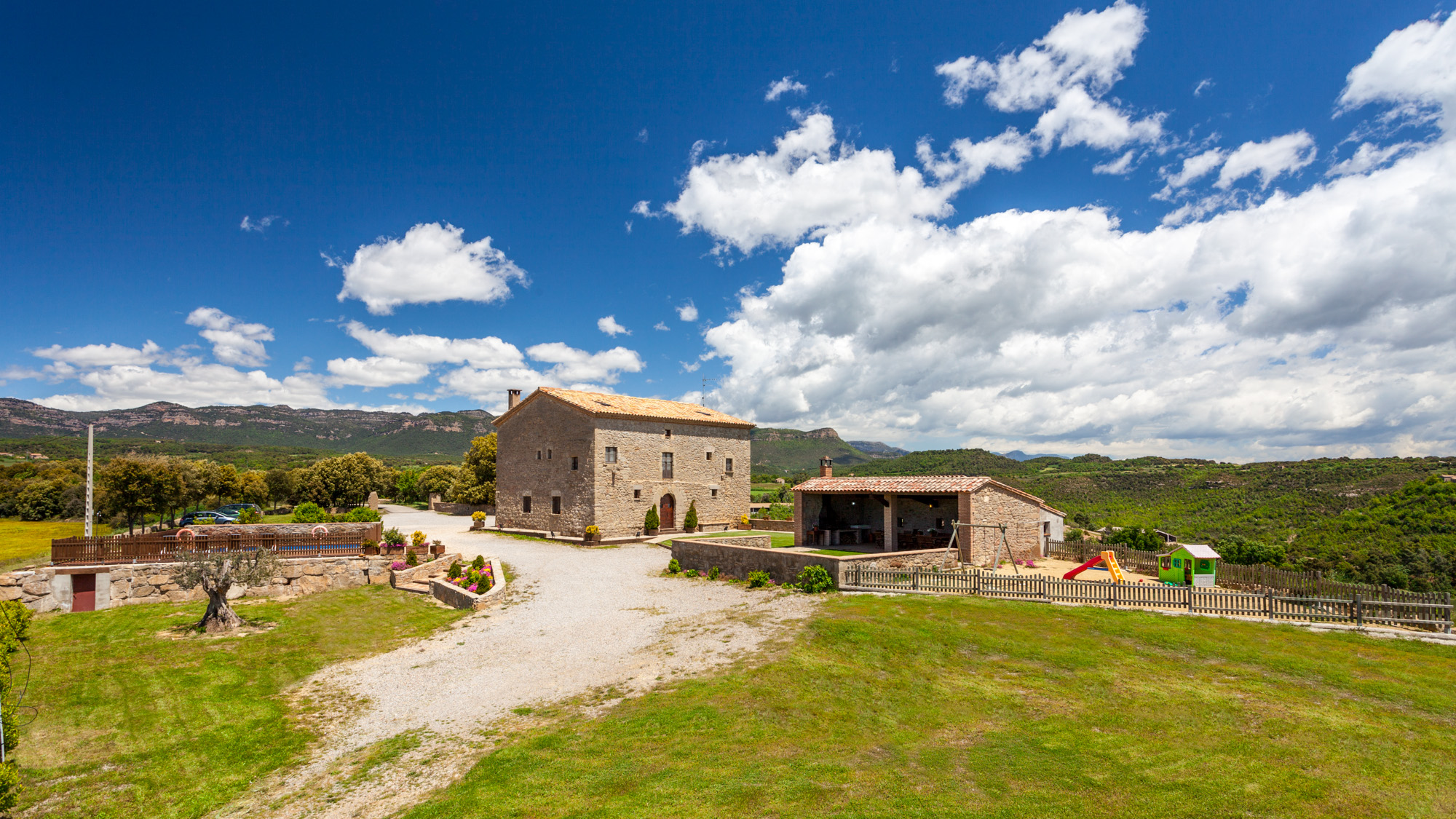
From La Tor de Montclar, the surrounding landscape exemplifies these water dynamics. The property itself relies on spring water, connecting directly to the karst aquifer system. Nearby streams descend toward the Llobregat, passing through forests that regulate water flow. The immediate area contains several gorgs and springs accessible via short walks, offering opportunities to observe karst hydrology in action.
Practical information
2-15 km to various springs and gorgs
Discover Berguedà from La Tor de Montclar
15th-century farmhouse with indoor pool, ideal for groups of up to 20 guests
Check availability